

Most Belgians are mildly surprised to learn how well-known A Dog of Flanders is in Japan. Ouida’s 1872 novel — set in the Flemish countryside outside Antwerp, following a boy named Nello and his dog Patrasche — is a staple of Japanese childhood in a way it has not been in Belgium or Britain for generations. The anime adaptation ensured that. Nello and Patrasche walking through the Flemish winter, the cathedral at Antwerp, the ending that Japanese audiences remember long after everything else fades — these are part of a shared cultural memory that runs in one direction across the North Sea. A Belgian strong ale named Patrasche is, in Japan, a beer with a name that needs no introduction. In Belgium, it is simply a good strong ale that chose a good name.
A modern Belgian strong ale, named for Flanders
Patrasche Beer is a modern Belgian strong ale, produced in Belgium as a contract-brewed product with production specifics that are limited in public documentation — the brewery involved is associated with Inbev/contract-brewed arrangements, with the founding of the Belgian craft (modern) range reflecting the broader expansion of Belgian-branded beers in the contemporary market. What the brief provides clearly is the beer itself: a pale gold strong ale at 8.0% ABV with the spicy yeast character, fruity esters, and warming finish that the Belgian strong ale style is built on.
The sensory profile follows the style’s established logic. The pour is pale gold — lighter in colour than the ABV might suggest — and the yeast character is spicy, the phenolic notes of Belgian high-temperature fermentation present in the aroma and on the palate. Fruity esters add complexity alongside the spice, and the warming finish from the 8.0% ABV arrives in the integrated way that a well-made Belgian strong ale delivers: present at the close of each sip without dominating what came before it. It is a beer that fits the category it belongs to, carrying the flavour markers of Belgian strong ale regardless of the production route that brought it to market.
How Patrasche Beer is drunk at home

Santé! / Op uw gezondheid! (sahn-TAY / op-uw geh-ZONT-hayt) — French and Flemish respectively, both meaning “to your health.” In Flanders, where Patrasche the dog walked his Flemish roads, the Flemish toast is the natural call — though both languages have always shared the same Belgian table.
In Belgium, a strong ale at 8.0% belongs to the deliberate part of the Sunday family lunch — the beer opened after the initial rounds have established the afternoon’s pace, when the food has moved past its lighter courses and the table has settled into conversation. Stoofvlees, the slow-braised beef stew reduced to a caramelised, sweet-savory glaze, is the pairing the Patrasche’s malt body and fruity yeast character handle with the most authority — a rich, slow-cooked dish alongside a strong ale that carries enough weight to meet it. Moules-frites suits the beer at an earlier point in the meal, the brine of the mussels and the salt of the fries working alongside the spicy yeast note without competition. Belgian fries with mayonnaise are present regardless of the course, and the warming finish of the Patrasche cuts their fat cleanly.
Belgian beer festivals, where the broader category of Belgian strong golden ales — Duvel, La Guillotine, and their contemporaries — defines a recognisable style grouping, give a beer like the Patrasche its natural context.
How to drink it in Japan

In Japan, the Patrasche name lands differently than it does anywhere else. The beer suits autumn most naturally — October through December — when the Flemish winter imagery associated with A Dog of Flanders is most present in the cultural imagination, and when a strong ale with warming finish fits the temperature. It is also the beer that makes the most sense as a conversation piece at a gathering of Belgians and Japanese guests in Tokyo: a shared reference point, two countries approaching the same bottle from different directions.
At Lawson, try it alongside a warm nikuman — the steamed pork bun at the counter, its mild sweetness and soft dough providing a neutral backdrop that lets the spicy yeast character of the Patrasche come forward. For a composed pairing at home, serve it with buta no kakuni — Japanese braised pork belly, slow-cooked with soy, mirin, and sake until the fat renders and the glaze deepens. The caramelised soy reduction and the fruity esters of the Patrasche find each other directly, the beer’s warming finish carrying the richness of the dish without being overwhelmed. It is the same logic as Stoofvlees alongside a Belgian strong ale, adapted entirely to Japanese ingredients.
Belgian strong ales of this style are not a category that Tokyo’s specialty import shops carry with consistency. By the case from Omori Mart — 330ml × 24 bottles — the per-bottle cost is accessible, and the Patrasche name means it is the one Belgian beer in the range that a Japanese guest at the table is likely to recognise before the first pour.
Get Patrasche Beer delivered in Japan
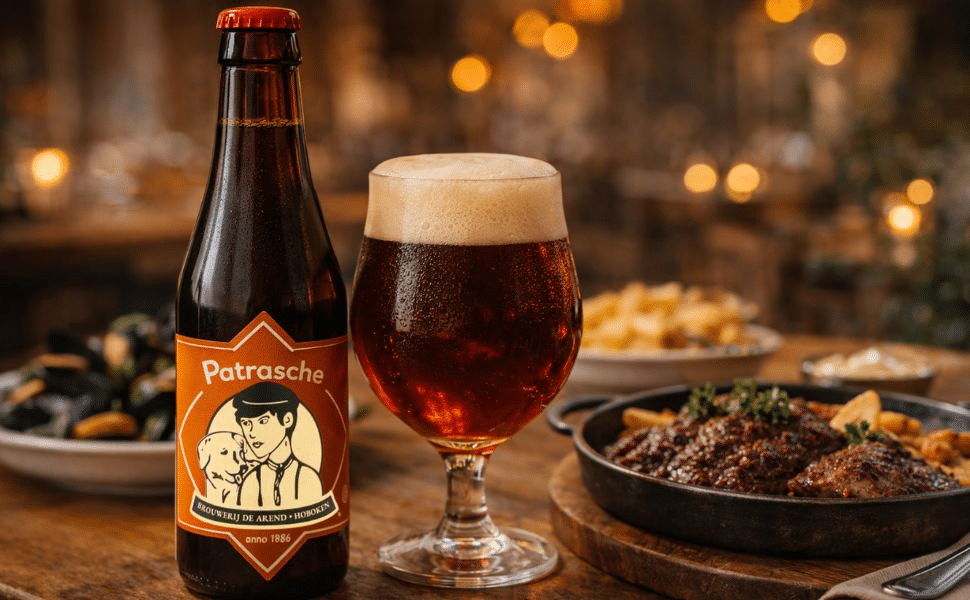
Patrasche Beer is available from Omori Mart in a 330ml × 24 bottle case, delivered nationwide across Japan.
- Free shipping on orders over ¥15,000
- Pay at FamilyMart, 7-Eleven, or Lawson — or by bank transfer or card
- Nationwide delivery to any address in Japan
Rakuten and Amazon Japan do not carry this label. Omori Mart is where Belgians in Japan find the beers that carry Flanders with them — including the one named for the dog that Japan never forgot.
[Shop Patrasche Beer →]
https://omorimart.com/product/patrasche-beer-330ml-x-24-bottles/
Santé in Flanders, where a boy and his dog walked roads that Japan has been imagining since 1872, and kanpai at a Tokyo table in November — pale gold, warming, and a name that crosses the distance without needing translation.



 No products in the cart.