

The Sunday biergarten table fills slowly and stays for hours. The chestnut trees provide the shade, the bratwurst arrives before anyone has decided on a second round, and the beer in the glass is pale gold, soft, and clean — the one that has been poured at this kind of table in Munich since before most countries had a national beer to speak of. If that Sunday is what you are missing in Tokyo or Yokohama, Hofbräu Original ships in cases of twenty-four and the table assembles itself.
Munich’s royal court brewery, Helles since 1589
Hofbräu Original is brewed by Staatliches Hofbräuhaus München, founded in 1589 by Duke Wilhelm V of Bavaria as the court brewery of the Bavarian royal household. The Hofbräuhaus has operated continuously since, through four centuries of Bavarian and German history, and remains state-owned today — a public institution as much as a brewing operation, with the Munich beer hall bearing its name one of the most visited buildings in Bavaria.
The beer is a Munich Helles — the pale lager style developed in Munich in the late nineteenth century as a Bavarian response to the pale Bohemian lagers that were gaining international popularity. Pale gold in the glass, with a soft malt sweetness, balanced noble hop bitterness, and a clean finish, the Helles is built to be drunk in volume at a biergarten table without demanding attention from the people sitting at it. At 5.1% ABV, it is a session beer in the fullest German sense: designed for an afternoon that has no fixed end time.
Staatliches Hofbräuhaus München’s 1589 founding gives Hofbräu Original one of the longest continuous brewing histories of any beer available in Japan, and the Helles it produces today is the direct descendant of the style that Munich’s royal court brewery standardised.
How Hofbrau Original Beer [ 330 ml x 24 Bottles ] is drunk at home

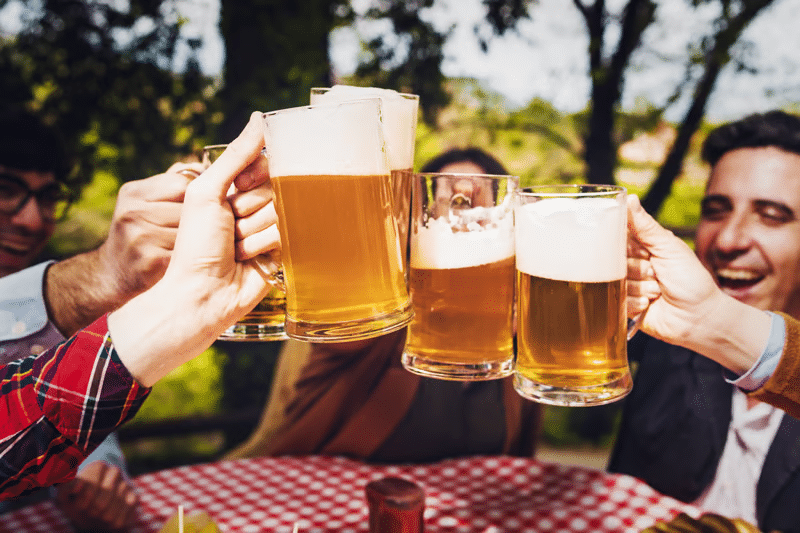
Prost! (PROAST) — German for “cheers,” said once, directly, with eye contact held through the clink. The rules are consistent: raise a beer glass, not a water glass, and hold the gaze until the glasses separate. At a biergarten table with eight people, the toast is a coordinated moment — everyone watches everyone else, and the round begins properly only when it is done right.
Bratwurst with mustard is the pairing that defines what a Bavarian biergarten is for — the charred sausage skin against the sharp mustard, the soft malt sweetness of the Helles cutting through the fat and providing the reset between bites that keeps the combination going. Pretzels — Brezel — are on the table from the moment anyone sits down, chewy and heavily salted, their texture and mineral saltiness making the noble hop balance of the Helles taste cleaner with each subsequent sip. Schweinshaxe, the slow-roasted pork knuckle with caramelised crackling skin, is the dish that makes a biergarten afternoon into a proper meal, and the Helles’s clean finish is what allows the richness of the pork to remain the centrepiece without the beer becoming a competing flavour.
Oktoberfest — late September through early October — is the annual occasion where the Hofbräuhaus beer hall becomes the world’s most famous venue for exactly this kind of drinking, replicated in Tokyo and Yokohama every autumn. Sunday biergarten afternoons are the year-round version of the same tradition, quieter and multigenerational, measured in how many rounds have gone by when the chestnut leaves start falling.
How to drink it in Japan

The Munich Helles style rewards being served properly cold — the soft malt sweetness and the noble hop balance both perform best at full fridge temperature, in a clean glass with a short head. The 330ml bottle is individual-serve sized, which makes it the right format for a dinner table or a small gathering rather than a shared jug. Pair it with a FamilyMart sausage roll or a heated bratwurst-style pork frank from the warmer counter — the closest approximation to the original pairing available at any hour across Japan.
For a sit-down pairing, try it alongside chicken schnitzel at a European-style restaurant in Tokyo — the breaded, pan-fried cutlet and the soft malt sweetness of the Helles work in the same direction that Schweinshaxe and Hofbräu do at home. The clean finish of the Helles resets the palate between pieces of the schnitzel without ever becoming the primary thing on the table. It is a pairing that makes the biergarten logic feel at home in a Tokyo dining room.
Autumn is the season that aligns most directly — Tokyo and Yokohama’s Oktoberfest events in September and October are the natural occasion — but a Sunday table with Hofbräu Original works in any season. At a German restaurant or Oktoberfest event in Tokyo, a 330ml Hofbräu runs ¥1,000 to ¥1,400. By the case from Omori Mart, the per-bottle cost is noticeably lower.
Get Hofbrau Original Beer [ 330 ml x 24 Bottles ] delivered in Japan
Hofbräu Original Beer (330ml x 24 bottles) is available now at Omori Mart, with nationwide delivery across Japan.
- Free shipping on orders over ¥15,000
- Konbini payment accepted at FamilyMart, 7-Eleven, and Lawson — plus bank transfer and card
- Nationwide delivery
Rakuten and Amazon Japan do not carry Hofbräu Original or other German home-country brands at this level. Omori Mart does.
[Shop Hofbrau Original Beer →]
https://omorimart.com/product/hofbrau-original-beer-330-ml-x-24-bottles/
Prost in Munich, pale gold and royal-court since 1589. Kanpai (乾杯) in Tokyo, where the biergarten table reassembles every autumn and the Helles that built it travels without losing anything on the way.


 No products in the cart.